War Memorial
A Short History Of The Royal Sutton Coldfield War Memorial
A Brief History Of The Royal Sutton Coldfield War Memorial
After the end of the Great War...
After the end of the Great War many towns and villages decided to erect memorials to commemorate the men from their communities who had paid the ultimate sacrifice. Sutton Coldfield was no exception.
These memorials were often seen as a focal point for future Remembrance Services.
They were also in many ways regarded as a way of passing history on to the generations still to come, in the hope that the Great War was indeed ‘a war to end wars’. Some viewed them as testaments to the horrors of war.
The Royal Sutton Coldfield War Memorial has become part of our local history and in this centenary year, a group of people came together to research those men who died during the Great War and whose names are on our War Memorial.
The Royal Sutton Coldfield Great War Project hope that their research will act as a further reminder to future generations that the effects of the Great War still resonate today.
A committee was formed
After the end of the war, as the local community was looking to the future, the subject of a memorial for Sutton Coldfield was discussed, principally it seems by those families of the ‘middle class’.
From the news cuttings from ‘The Sutton Coldfield News’ dating from 10 May 1919, it appears that not everyone in the community wanted or supported a memorial.
Headed ‘Noisy Meeting’, the report in the edition of ‘The Sutton Coldfield News’ dated 10 May 1919 describes a public meeting at the Town Hall that had been called to inaugurate a voluntary fund of subscriptions to pay for a war memorial to be built.
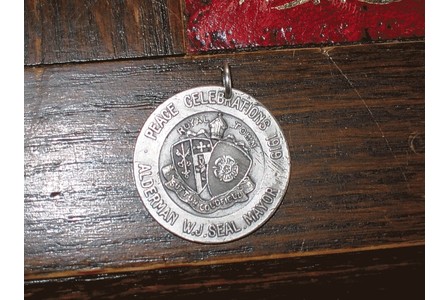
The meeting was chaired by the Mayor Alderman W J Seal. Others present included Rev. Canon Barnard, Alderman E Ansell, Joseph Ansell, Alderman and Mrs S C Emery, Lieutenant Colonel C Fiddian Green, Dr A H Evans, Mr R Turner and May Turner, Captain R A Reay- Nadin (Town Clerk), Councillor W T Harrison, Mr G Hooper, John Ellison, Mr S E Pritchard, Alderman W H Evans, Mr and Mrs F Rathbone and others.
The Mayor stated that the objective of the meeting was to start the voluntary donations towards the memorial rolling and ‘to try to avoid controversy’. He saw the committee’s first duty was ‘to establish something which would be a lasting recognition of the valuable lives given up for their country and their homes’.
At that stage the report mentions heckling from the crowd.
The report goes on to state that some designs of memorials were on show, but mainly just for ideas.
Mr G Sidwell, ‘on behalf of the working classes’ agreed that a war memorial ‘should be erected but that the community had gone the wrong way about it’.
Mr Sidwell stated that ‘a public meeting should have been called before a committee was set up’. He suggested that the committee was calling the tune whilst the public ‘were put in the shade, and it would not fully represent Sutton Coldfield’.
Here it was reported that there was considerable noise from the crowd. It seems that many of the ordinary working people of the town felt that the rich people had gone ahead with their own opinions and ideas without any consultation of the whole community.
Mr Green, from the audience, suggested that ‘the committee was thwarting their wealth around before the public, and it should be a public memorial not one designed and paid for by rich men’.
Mrs Rathbone suggested that it was necessary that the wishes of the bereaved be expressed. She said that some people favoured a home for disabled men or something to help disabled men and the bereaved families of the fallen. Other ideas included the building of a public baths or alms houses.
The committee however seemed to gain ground and moved the discussions back to the ideas and designs of ‘their’ war memorial (the feeling from the report was that the ‘rich men’ would not be moved from their lofty ideas and bow down to the ‘lesser classes’ thoughts and feelings).
For several weeks during May, June, July, August, and September there were many letters sent to ‘The Sutton Coldfield News’, some quite vitriolic, outlining the divisions between the classes – rich versus the poor, employers versus the working class and there was much criticism of the way the ‘rich men’ had taken it upon themselves to form a committee of their own ranks without first consulting the wider community.
One frequent correspondent was Albert Green who stated he was “setting out the case against the rich” and was “Taking up the cause of the working classes and those who had served”. He signed himself as “Cockney” of 25 Lyndon Road on 26 May 1919, and at other times as Ex Private 9173, 5th South Staffordshire Regiment.
On 15 November 1919, an ‘Opposition Meeting’ was called, held at the Town Hall. Mr T W Lawrence of Maney presided.
The purpose of the meeting was to hear the views of the ‘inhabitants’ as to what shape the war memorial should take, including the views of those against having it placed in the park or at the gate to the park as many ‘rich men’ had suggested.
Strong views were put that the actual memorial should take the form of a public hall or public library rather than a monument. The town was in great need of both, according to Mr Green.
Needless to say, the ideas of the upper classes prevailed, and the committee went ahead with the voluntary donations and the plans to build what became the war memorial that we see today.
By 1921, the committee were ready to ask for designs and instigated a war memorial design competition. On 4 May 1921, the Royal British Institute of Architects wrote to the Town Clerk to acknowledge the competition.
On 16 April 1921, Mr E N Cowell of 6 Wellington Terrace, Sutton Coldfield wrote to T Ellison Esq, Town Clerk asking for more details about the competition.
On 17 August 1921, another hopeful, Clement W Jewitt of 59 Linzee Road, Hornsey, London N8 wrote to the town clerk stating he had submitted designs and wondered when he would hear more.
On 28 October 1921, Messrs A & F Manuelle Ltd of London, Stone Merchants, wrote to state they were sending samples of granite for the committee to look at.
Eventually the position of designing and building the war memorial went to Francis William Doyle-Jones of 2 Wentworth Studios, Manresa Road, Chelsea, London. However, any actual correspondence from or to Doyle-Jones was not found in archive materials held by Sutton Coldfield Library.
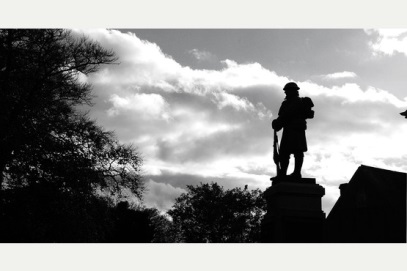
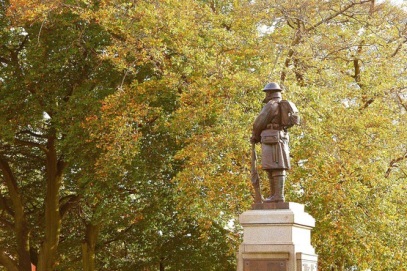
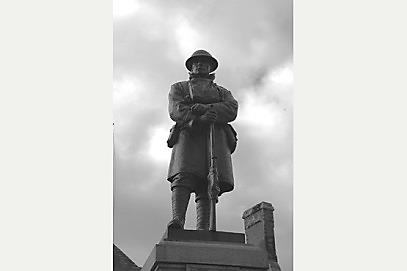
A contract was drawn up by the Mayor, George Richard Hooper and Doyle-Jones for the building of a 1.8 metre bronze statue on a 4.6 metre pedestal of Dalbeattie granite.
Names and initials were to be incised in ‘v’ shapes into the stone, with no more than 300 names, which were to be toned with bronze paint.
(It has to be asked – why did they state no more than 300 men?)
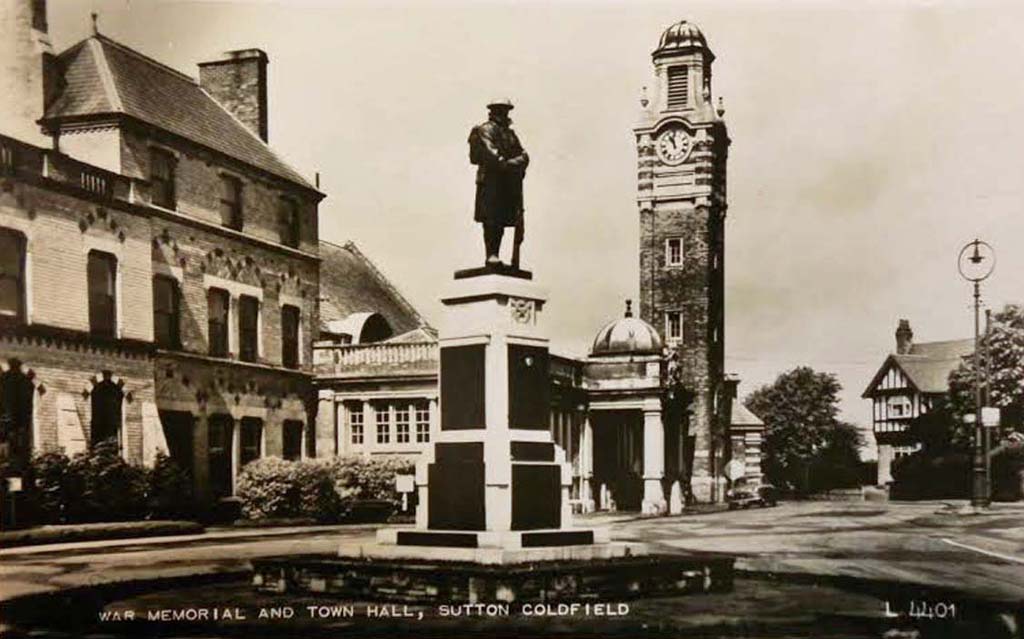
It was eventually agreed that the siting of the war memorial would be adjacent to the Town Hall in King Edward Square.
The Town Hall itself had started life in 1865 as a hotel. The Town Hall had been used as a location where men could go to enlist to serve in the war. By 1919, the Town Hall was being used as a theatre to entertain discharged or demobilised soldiers.
Part of the building was more recently used by Birmingham City Council as a council house and a hall for public and private events. It is now a Grade ‘A’ locally listed building.
The War Memorial was desecrated by vandals in June 1965 and was given a facelift in 1979 when the metal plaques were added.
The former council chambers are now in the ownership of Gethar Ventures (as Court Collaboration), who are converting the building into luxury apartments.
Francis Doyle- Jones
The Building Of The War Memorial
After much debate Francis Doyle-Jones was selected to build the memorial by the Sutton Coldfield District Council in November 1919 on the condition that he promised not to produce a model anything like it in Warwickshire and only another two of the same design anywhere else in the country.
The project was funded solely by public voluntary subscriptions.
Some of the committee meeting minutes and letters between interested parties survive and can be viewed at Sutton Coldfield Reference Library.
Doyle-Jones had completed his clay model by March 1922 and the bronze figure by July 1922.
The unveiling ceremony was planned for 31 August 1922, but this was delayed due to problems with the stone mason.
Eventually the unveiling ceremony took place on 1 November 1922.
The total cost of the project was £1650.
The inscription on the memorial reads:
“Erected to the glorious memory of the men of Sutton Coldfield who gave their lives in the Great War 1914 -1919 and they died that we may live.”
THE ELLAND MEMORIAL
There was only one other memorial made to the same design by Doyle-Jones.
This was the ‘Elland Memorial’ at Elland in West Yorkshire. It is situated at the entrance to Hullenedge Park, Elland.
Due to the delays in completing the memorial at Sutton Coldfield caused by the stone mason, the Elland Memorial was the first to be unveiled.
This took place on Saturday 16 September 1922.
FRANCIS DOYLE- JONES
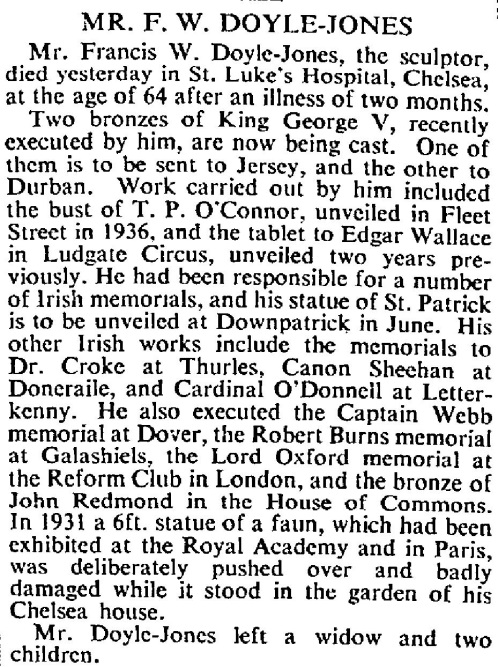
Francis W Doyle- Jones was born in 1873 at West Hartlepool and died in 1938 in London.
Above is a copy of his obituary in ‘The Times’, Wednesday 11 May 1938 (courtesy of David Glanfield).
(Source: archive materials held at Royal Sutton Coldfield Library and ancestry.co.uk)


Derrick Griffin discovered this invitation at a school jumble sale about 35 years ago
The Order Of Service For The Unveiling Ceremony
2.50 pm: Guard of Honour 8th Battalion Royal Warwickshire Regiment
Representatives of Cadets, Ex-Servicemen, British Legion, Volunteers etc.
Hymn: O God our help in ages past
Reading: Canon Barnard
Lesson St Matthew V1: Rev T W Merlin (Congregational)
Lord’s Prayer
Prayer: Rev Frank Cox (Wesleyan)
Chairman of the Memorial Committee F M Robertson invited to unveil the Memorial
Guard of Honour presents arms
Short address by F M Robertson
The Mayor accepts the guardianship of the Memorial on behalf of the town
Dedication of the Memorial by the Right Reverend, the Lord Bishop of Birmingham
Short address by the Bishop of Birmingham
The Last Post
Pause
Reveille
A wreath is laid at the Memorial on behalf of the town
Inspection of the Guard of Honour, the British Legion, Ex-Servicemen, Cadets etc.
National Anthem
Light refreshments in the Town Hall
(Source: transcription from archive materials held at Royal Sutton Coldfield Library)
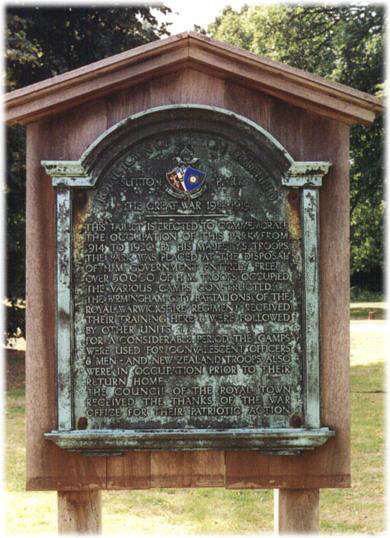
A memorial tablet was erected in Sutton Park to commemorate the very important role the park played in the training and housing of troops during the Great War.
The inscription reads:
“This tablet is erected to commemorate the occupation of this park from 1914 to 1920 by His Majesty’s troops.
The park was placed at the disposal of H.M. Government entirely free.
Over 50,000 of H.M. troops occupied the various camps constructed. The Birmingham City Battalions of the Royal Warwickshire Regiment received their training here and were followed by other units.
For a considerable period the camps were used for convalescent officers and men – and New Zealand troops also were in occupation prior to their return home.
The council of the royal town received the thanks of the War Office for their patriotic action.”
By Robert Lawrence Binyon (1914)
For The Fallen
With proud thanksgiving, a mother for her children,
England mourns for her dead across the sea.
Flesh of her flesh they were, spirit of her spirit,
Fallen in the cause of the free.
Solemn the drums thrill; Death august and royal
Sings sorrow up into immortal spheres,
There is music in the midst of desolation
And a glory that shines upon our tears.
They went with songs to the battle, they were young,
Straight of limb, true of eye, steady and aglow.
They were staunch to the end against odds uncounted;
They fell with their faces to the foe.
They shall not grow old, as we that are left grow old:
Age shall not weary them, nor the years condemn.
At the going down of the sun and in the morning
We will remember them.
They mingle not with their laughing comrades again;
They sit no more at familiar tables of home;
They have no lot in our labour of the day-time;
They sleep beyond England’s foam.
But where our desires are and our hopes profound,
Felt as a well-spring that is hidden from sight,
To the innermost heart of their own land they are known
As the stars are known to the Night;
As the stars that shall be bright when we are dust,
Moving in marches upon the heavenly plain;
As the stars that are starry in the time of our darkness,
To the end, to the end, they remain.
This poem reflects the history of war and the importance of remembrance. It is fitting that it is included here.
Robert Lawrence Binyon (1869 – 1943)
He was born into a Quaker family at Lancaster. He went to trinity College, Oxford to read Classics. After university, he went to work at the British Museum.
He was moved by the numbers of men who were wounded in 1914 at the outbreak of war. He wrote this poem whilst walking by cliffs in Cornwall in 1914. This was at the time when public feeling was high after the many casualties that occurred during the Battle of Marne. The poem was published in ‘The Times’ in September 1914.
Binyon volunteered as a hospital orderly looking after wounded French soldiers at Haute- Marne and later at Verdun (1916).
The Young Soldiers Do Not Speak
By Archibald MacLeish
The young dead soldiers do not speak.
Nevertheless, they are heard in the still houses:
who has not heard them?They have a silence that speaks for them at night
and when the clock counts.They say: we were young. We have died.
Remember us.They say: We have done what we could
but until it is finished it is not done.They say: We have given our lives but until it is finished
no one can know what our lives gave.They say: Our deaths are not ours: they are yours,
they will mean what you make them.They say: Whether our lives and our deaths were for
peace and a new hope or for nothing we cannot say,
it is you who must say this.We leave you our deaths. Give them meaning.
We were young, they say. We have died; remember us.
This poem was suggested by David Phillips as a fitting tribute to all war heroes.
(David Phillips, Bishop Vesey’s Grammar School, Royal Sutton Coldfield Great War Project)
Archibald MacLeish
Archibald MacLeish was born in Illinois, USA in 1892 to a Scottish father and an academic mother.
He joined the Great War in 1917, when he served in France as an ambulance driver with the Yale Mobile Hospital Unit.
He soon transferred to the “B” Battery of the 146th Field Artillery ,where he reached the position of First Lieutenant.
He was a well – known American poet, writer, and Pulitzer Prize winner and became the Librarian of Congress.
He died in 1982.
Index of the Names Researched
ADCOCK JAMES
ALDRIDGE ERNEST
ALLDAY FRANK LESLIE
ALLEN – SHUKER HENRY EWART GLADSTONE
ALLENDER IVON RAYMOND
ANDREWS JOSEPH
ANGELL RICHARD SIDNEY
ANSELL HARRY CLEMENTS
ARBERY JOHN SAMUEL
ARNOLD ERNEST ALFRED
ARNOLD OLIVER VAUGHTON
ASH GEORGE
ATKINS PERCY FREDERICK
BAILEY LINNAEOUS JAMES
BAILEY SELWYN GLADSTONE
BAINES AFRED HENRY
BAKER ALFRED
BARBER HARRY
BARRATT HAROLD
BASTABLE JOHN
BATE ALFRED GEORGE
BATE ARTHUR CHARLES
BATE WILLIAM HENRY
BEACH WALTER
BEARD FREDERICK JOHN
BEDDOES EDWIN THOMAS
BENNETT GEORGE THOMAS
BICKLEY CHARLES
BICKLEY WILLIAM ALFRED JAMES
BINNELL SAMUEL JOHN
BIRD WILLIAM HENRY
BLISS ARTHUR JAMES
BLOCKLEY PERCY GEORGE
BOUGH EWART THOMAS
BOWER ALFRED PERCY
BOWERS CHRISTOPHER WILLIAM HENRY
BRADBURY JOHN FREDERICK
BRADFORD FREDERICK WILLIAM
BRASSINGTON HENRY WILFRED
BRATT RAYMOND DOUGLAS
BRAYSHAY WILLIAM STEAD – not on the memorial
BROMWICH EDGAR JOHN
BROMWICH LESLIE FRANK
BROWN EDWARD
BROWN HARRY SEYMOUR
BROWN JOHN RAYMOND
BUSHELL ROLAND
BUTLER FRANK STANDLEY
CAPENER JOSEPH HENRY
CARPENTER GABRIEL
CARTER ARTHUR
CARTWRIGHT EDWARD
CASHMORE HOWARD PARKER
CASHMORE HOWARD VICTOR
CASHMORE JOHN
CAVIT SYDNEY NORMAN
CHAMBERLAIN GEORGE NELSON
CHOPPING BERTRAM CLIVE
CLARK CHARLES PHILLIP
CLARKE ALBERT WILLIAM
CLARKE ARTHUR
CLARKE NATHANIEL FURHMANN
CLEAVE NORMAN
CLIBBERY BERTRAM EVELYN GEORGE
COBB FREDERICK HENRY
COCKBILL FREDERICK HENRY
COFIELD WILLIAM JOSEPH
COHEN HARRY ALBAN PALMER
COLBOURN CYRIL GEORGE
COLE FREDERICK WILLIAM
COLES ALBERT HENRY
COLEMAN AUSTIN VERNON
COLLIER FREDERCK HENRY DOUGLAS
COLLINS ARTHUR A
COLLYER FRANK HOWARD
COLYER BERNARD CHARLES
COOMBE WILFRED
CORBY MATTHEW SYDNEY
COUCH HAROLD JEROME
CRIPPS FRANK HENRY
CROSS GEORGE WILLIAM
CROWTHER ARTHUR
CROZIER NORMAN
DALE ZACHARIAH
DANKS WALTER
DAVIS A (ALFRED)
DAVIS EDWARD
DAVIS HOWARD
DAVIES TREVOR ARTHUR MANNING
DAWSON STEPHEN TURNER
DEVILLE WILLIAM
DeLATTRE REGINALD (REX)
DEWSBURY T – SEE JOHN TREVOR DEWSBURY
DEYKIN CECIL JOHN
DILLON TED
DOWDING ROBERT
DOWNING ERNEST
DOWNING WILLIAM
DUESBURY JOHN TREVOR
EADS ANTHONY
EADS GEORGE PHILLIP
EAGLES HUBERT
EDGE REGINALD FREEGARDE
EDWARDS-WOOD THOMAS LIONEL
ELLISON DOUGLAS HEMS
ELLISON STANLEY JOHN
ELVINS ERNEST
EVANS A H (ARTHUR?)
EVANS HAMBLETT POOLE
EVANS PHILIP MARSH
EVANS RICHARD RALPH
FELLOWS HAROLD JOHN
FELTON JOHN HOWARD
FLETCHER WILFRED HORACE JOHN
FOLLAND ALBERT
FORGE HENRY NOEL FRANCIS
FOX HARRY
FRENCH GEORGE HERBERT
GARNER WILFRED
GIBBINS (GIBBONS) JOHN SAMUEL
GIBBS ARTHUR LEEK
GIDMAN JOHN
GILBERT ALBERT EDWARD
GILBERT WILLIAM
GODFREY WILLIAM
GOLDSTRAW EDWIN WALTER
GOOD ARTHUR ERNEST
GOODE PERCY CHARLES
GOODENOUGH ALFRED EDWARD
GOODING FREDERICK REGINALD COOMBE(S)
GOODWIN THOMAS JAMES
GOODWIN WILLIAM COLLETT
GREATREX HORACE
GREEN ALBERT JOHN
GREEN GEORGE OLIVER GILBERT
GREEN HERBERT WILLIAMS
GREEN TOM WILLIAMS
GREENER LEYSTERS LLEWELLYN
GREENWOOD THOMAS
GROVE PERCIVAL ALLEN
GWYNN GEORGE
HACKETT JOHN HENRY
HALFORD FREDERICK CHARLES
HALL THOMAS CHARLES
HALLEWELL GEORGE NOBLE
HANDS THOMAS PHILIP
HARCOURT WILFRED
HARLOND HUGH
HARMAN WALTER EWART
HARRISON SIDNEY
HARRISON THOMAS GREVILLE
HARRISON WALTER
HARROP ARTHUR REX
HAVELL ERNEST HUBERT
HEEKS WILLIAM HENRY – not on the Memorial
HEMMING ERNEST
HIGGS ALFRED
HIGGS CHARLES ARTHUR
HIGGS JOHN HENRY
HILL OWEN WILLIAM
HINCE WILLIAM JOSEPH
HODSON ARTHUR COKE
HOLBECHE EDWARD
HOLMES FREDERICK HOWARD
HORTON FRANK
HORTON FREDERICK
HOWELL ROBERT RUTTER
HUDSON R – not identified
HUMPHRIES (HUMPHRIS) BERT HAROLD
HUTTON ARCHIBALD GIBSON BALFOUR
HUTTON JOHN BARNABAS
HUXLEY GEOFFREY JENNINGS
ILIFFE FREDERICK HORACE
INCHLEY PERCY CLIFFORD
IRELAND GEORGE
JACKSON A H (HERBERT ARTHUR)
JACKSON CYRIL
JACKSON ERNEST
JACKSON G E – not identified
JAMES ALBERT EDWARD
JAMES LESLIE ERNEST
JEANS GEORGE EDWARD FRANCIS
JEFFERIES SIDNEY WILFRED
JEFFRIES G A – not identified
JOHNSON ARTHUR
JOHNSON ARTHUR EDGAR
JOHNSON WILLIAM HERBERT M
JONES GEORGE LEONARD
JONES HORACE
JONES WILLIAM
JUXON WILLIAM HORACE
KEAY EDWARD
KELLEY VICTOR JAMES
KENT CHARLES ERNEST
KENT FRANCIS JOSEPH H H
KING ALFRED JOHN
KING JOHN
KITCHEN GEORGE ARTHUR
KNIGHT EDWIN DENNIS
KNOTT EDWARD MIDDLETON
LAKIN FREDERICK
LAKIN WILLIAM
LANGSTON ARTHUR VICTOR
LARKINS JOHN COLIN
LARNACH PRIMROSE LOGAN
LAVELLE HARRY
LAWRENCE VALENTINE ALBERT
LAX DONALD
LEE HAROLD
LILLEY GEORGE TOMLINSON
LILLY ARTHUR JOHN
LITTLE CHARLES FREDERICK
LOVELAND CHARLES
LOXTON ERNEST ADSHEAD DUDLEY
LUBY THOMAS WILLIAM
LUCAS GEORGE
LYNCH JOSEPH
MANNALL SYDNEY
MACSWINEY FELIX DESMOND – not on the memorial
MARKWICK EDWARD BAGULEY
MARLOW FRANCIS JOHN
MARTIN GEORGE RUSSELL COURTNEY
MATTHEWS EDWIN HAROLD
MATTHEWS LESLIE HERBERT
MAYO HAROLD GRAHAM
McANDREW CHARLES ROY
MERCER T – not identified
MERCER WILLIAM
MERRY ROBERT
MILLER ARTHUR BERNARD
MILLER FREDERICK GEORGE
MILLNER HORACE BROOKS
MILLWARD ERNEST REGINALD
MILLWARD HENRY CHARLES
MORGAN VINCENT HAROLD
MOORE JOHN FLETCHER
MOORE WILFRED ENGLEBURTT
MORRELL HARRY
MORRIS PERCY JOHN
MUTLOW ALFRED
NICHOLLS EDWIN JOHN
NODEN FREDERICK WILLIAM
OLIVER OWEN
OLDNALL WILLIAM ERNEST
ONIONS WILLIAM LESLIE
OWEN THOMAS STARR
OWEN W H – not on the memorial, not identified
PARKES HENRY GORDON
PARROTT ERNEST GEORGE
PARSONS SEPTIMUS ERIC
PAYNE JOHN NELSON
PEAKE WILLIAM EDWARD
PERKS ARTHUR EDGAR
PERKS JAMES FRANCIS – not on the memorial
PERKS SIDNEY/SYDNEY
PERRETT DENNIS VICTOR
PERRY PERCY HENRY
PERRY WILLIAM CHARLES
PICKERING GEORGE ANTHONY WILLIAM RAYMOND
PINFOLD ROBERT CECIL
PINSON GEORGE EDWARD
PLATT SAMUEL WILLIAM WOODGATE
POOLMAN ARTHUR GEORGE
PORTMAN HENRY
POWIS HARRY
POWIS WILLIAM HENRY
PREEDY LAWRENCE JACK
PRICE JOHN WILLIAM
PRICE THOMAS (JOSEPH WILLIAM)
PRING P- not identified
PRITCHARD JOHN ERIC STIRLING
PURDOM ARTHUR EUGENE MOLONY
RANDALL FREDERICK ARTHUR BRISTOL
REEVE HERBERT JOSEPH
REID JAMES
RENAUD ARTHUR LAMB
REYNOLDS GEORGE HENRY
RICE FRED/FREDERICK
RIPPINGILLE FRANK ALEXANDER
ROBBINS ALBERT
ROBBINS GEORGE
ROBERTS JOHN
ROBERTSON FREDERICK WILLIAM
ROBINSON JAMES
ROGERS GEORGE HENRY – not on the war memorial
ROPER HARRY
ROSE CHARLES ERNEST
ROSE MARK
RUSSELL WALTER WILLIAM
SALMON STANLEY FRANCIS
SALT ALFRED (also known as Edward)
SALT GEORGE GOODWIN
SALT JOHN
SAMPSON WALTER BLAGDON
SANBY HAROLD ERNEST
SANBY WILLIAM WORTHINGTON
SCOTT WALTER
SEATON WALTER JOHN
SEELEY HERBERT REGINALD
SHEARS CHARLES JOHN
SHENTON HORACE EDGAR
SHINE EDWARD
SHORT HAROLD REGINALD
SHOWELL JAMES
SIMPSON GEORGE
SIMPSON WALTER ERNEST
SLATER JAMES HENRY
SMITH BENJAMIN
SMITH CHARLES CYRIL
SMITH GERALD SYDNEY
SMITH HARRY CARTER
SMITH THOMAS
SPENCER GORDON
SPOKES ALBERT HENRY
STARKEY JOHN
STEELEY MARK JOHN
STEVENS ALFRED
STONEHOUSE THOMAS HAROLD – also as Harold Thomas
STONEHOUSE THOMAS
STORER ERNEST
STREATHER FREDERICK
STREATHER GEORGE
SYLVESTER ALBERT
TURNER TAYLOR SIDNEY ARNOLD
TEASDALE BERTIE LEONARD
THACKER PERCY HORACE
THORNTON SIDNEY/SYDNEY HERBERT
TIDMAS GEORGE JAMES – as Tidman on the memorial
TOMBS WILLIAM HENRY
TOWNLEY BERTRAM RUSSELL
TOWNLEY FELIX LIONEL
TOY ALFRED JOHN
TUFFLEY DAVID WILLIAM
TURNER CHARLES
TURNER RUSSEL SANDON
VAUGHTON GUY EGLINGTON
VYSE SAMUEL JOHN
WADEY WALTER
WAGSTAFF EUSTACE BERTRAM
WAKEFIELD ALBERT EDWARD
WALDRON ROBERT WILLIAM
WALKER ERIC ARTHUR
WARD FRANCIS BERNARD
WARMINGTON CYRIL
WARWOOD FRANK
WASHBOURNE CHARLES JOHN
WATSON OSWALD
WEBB CHARLES
WEBB GEORGE THOMAS
WEBB JOHN
WEBB JOSEPH WILLIAM
WEBSTER JAMES GORDON
WESTWOOD STANLEY BENJAMIN
WHEELER WILFRED HENRY – also known as Wilfrid
WHITE ERNEST
WHITE ERNEST ARTHUR GORDON
WHITE FRED
WILKINS ALBAN LESLIE
WILLIAMS JOHN MORRIS
WILLIAMS WILLIAM ALFRED
WILSON – BROWNE ROWLAND MURRAY
WINKLEY SYDNEY JOSEPH
WOODWARD HARRY IVINS
WOODWARD RAYMOND LEWIS
WRIGHT FRANK
WRIGHT JAMES